Texas Property Tax Protest Letter Template 2026: Free Sample + Filing Guide
Download a free Texas property tax protest letter template for 2026. Step-by-step instructions for writing your Notice of Protest, what to include, and common mistakes that get protests dismissed.
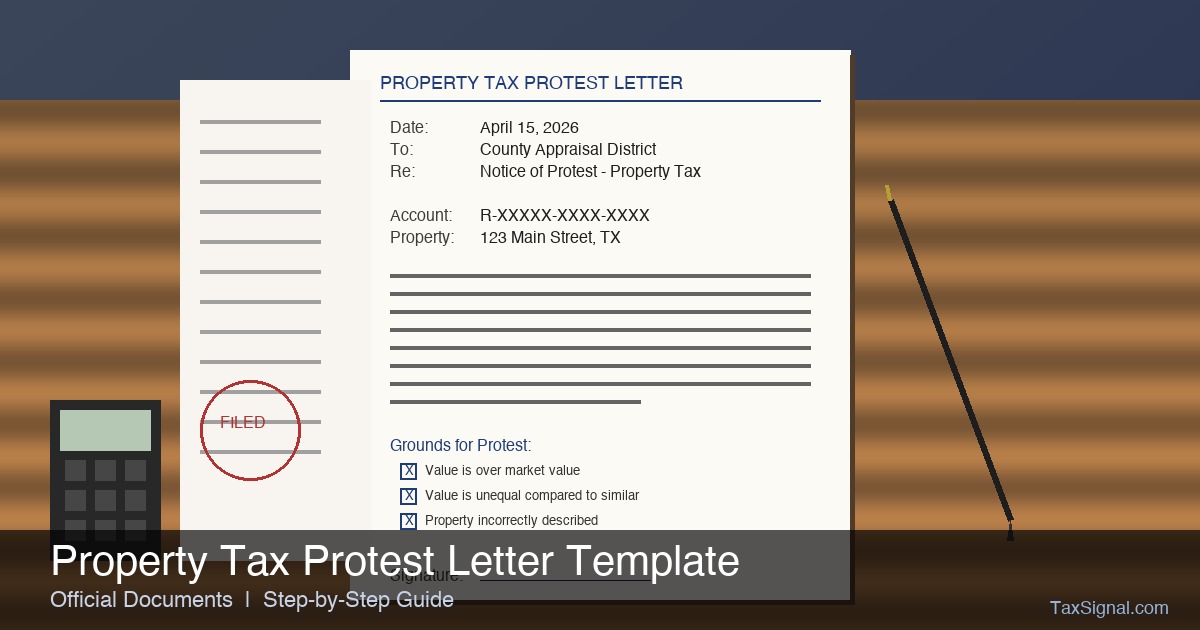
Filing a property tax protest in Texas starts with one document: the Notice of Protest. Get it right and you're on your way to a hearing. Get it wrong—or miss a required field—and your protest may be dismissed before anyone looks at your evidence.
This guide gives you a ready-to-use protest letter template, explains when you actually need a letter versus filing online, and walks you through the mistakes that trip up thousands of Texas property owners every year.
---
Do You Need a Protest Letter or an Online Filing?
Most Texas property owners don't need to write a letter at all. Every major county appraisal district now accepts electronic protests, and for the majority of filers, online is faster and less error-prone.
When online filing makes sense:- You're protesting a single property
- Your county supports electronic filing (most do)
- You want instant confirmation that your protest was received
- You're filing by mail because you prefer a paper trail
- Your county's online system is down or unavailable
- You're filing on behalf of someone else (with authorization)
- You're protesting multiple properties and want to include a cover letter with supporting context
---
Understanding Form 50-132: The Official Notice of Protest
The Texas Comptroller's Form 50-132 is the standard Notice of Protest form used statewide. You can download it from your county appraisal district website or from the Texas Comptroller's site.
The form asks for:
- Property owner name and mailing address
- Property account number (found on your Notice of Appraised Value)
- Property address being protested
- Reason(s) for protest — you check one or more boxes
- Description of your disagreement — a brief written explanation
- Signature and date
The Reason Checkboxes — What to Check
Form 50-132 gives you several protest grounds to select. The most commonly used are:
- "Value is over market value" — The most common reason. You're arguing the appraisal district set your property's market value too high compared to what it would actually sell for.
- "Value is unequal compared with other properties" — You're arguing that similar properties in your area are assessed at lower values per square foot. This is the "equity" or "uniform and equal" argument.
- "Property should not be taxed in this jurisdiction" — Rarely used by residential owners, but relevant if you believe an exemption applies.
- "Other" — Use this for factual errors like wrong square footage, incorrect property characteristics, or a missing exemption.
---
Free Protest Letter Template
If you're mailing your protest or want to include a cover letter with your Form 50-132, use this template. Replace the bracketed fields with your information.
---
> [Your Full Name] > [Your Mailing Address] > [City, State ZIP] > [Phone Number] > [Email Address] > > [Date] > > [County] Appraisal District > [District Mailing Address] > [City, State ZIP] > > Re: Notice of Protest — Property Account #[Account Number] > Property Address: [Full Property Address] > > Dear Appraisal Review Board: > > I am writing to formally protest the 2026 appraised value of the above-referenced property. The current appraised value of $[Appraised Value] does not accurately reflect the market value of this property. > > Reason(s) for Protest: > > - The appraised value exceeds the property's market value based on comparable sales in the area. > - The appraised value is not uniform and equal compared to similar properties in the neighborhood. > - [Optional: The property records contain errors, specifically: (describe errors such as wrong square footage, incorrect year built, missing condition issues, etc.)] > > I intend to present evidence supporting a lower valuation at my hearing and respectfully request that my protest be scheduled at the earliest available date. > > I have enclosed the completed Form 50-132 (Notice of Protest) with this letter. > > Sincerely, > > [Signature] > [Printed Name] > [Date]
---
Important: The letter alone is not sufficient. You must also submit the completed Form 50-132. The letter serves as a cover that provides additional context—it does not replace the official form.---
Online Filing Options by County
If you'd rather skip the letter entirely, here's where to file electronically for Texas's largest counties:
- Harris County (HCAD): Use the iFile system at hcad.org — the largest district in Texas, handles over 1.8 million accounts
- Dallas County (DCAD): Electronic protest filing available through the DCAD website at dallascad.org
- Tarrant County (TAD): E-file through the TAD portal at tad.org
- Travis County (TCAD): Online protest system available at traviscad.org
- Collin County (CCAD): File electronically through the CCAD website at collincad.org
- Bexar County (BCAD): Online filing available at bcad.org
---
Common Mistakes That Get Protests Dismissed
Filing a protest is straightforward, but these errors cause real problems:
1. Missing the deadline. The standard deadline is May 15, 2026, or 30 days after the date on your Notice of Appraised Value—whichever is later. Miss it and there are no second chances. 2. Wrong property account number. If the account number on your filing doesn't match, your protest may be applied to the wrong property or rejected entirely. Double-check it against your Notice of Appraised Value. 3. Not checking any reason box. The form requires at least one reason for your protest. Leaving the reason section blank gives the district grounds to reject your filing as incomplete. 4. Filing for the wrong tax year. Make sure you're protesting the 2026 assessed value, not a prior year. The form and your letter should reference the current tax year. 5. Forgetting to sign the form. An unsigned Notice of Protest is invalid. If you're filing by mail, sign it before sending. If filing online, complete the electronic signature step. 6. Sending evidence with the initial filing. Your protest letter is just the filing—save your evidence for the hearing. Including comps and photos with the initial notice doesn't help and sometimes gets lost before your hearing date.---
What Happens After You File
Once your Notice of Protest is received, here's the typical timeline:
1. Confirmation — You'll receive an acknowledgment from the appraisal district (usually within 1-2 weeks for mail, instantly for online) 2. Hearing notice — The district will schedule your hearing and notify you of the date, time, and location (typically 4-8 weeks after filing) 3. Informal hearing — A one-on-one meeting with an appraiser where most cases settle. Come prepared with your evidence. 4. Formal ARB hearing — If you don't settle informally, your case goes before the Appraisal Review Board panel
The filing is the easy part. Winning the hearing is where preparation matters. You need comparable sales data, neighborhood analysis, and a clear argument for why your assessed value is too high.---
The Letter Doesn't Win the Protest — Your Numbers Do
Here's the truth most template guides won't tell you: the protest letter is just a procedural step. It gets you in the door. What actually determines whether your assessment gets reduced is the evidence you bring to the hearing.
The strongest protests are built on:
- Comparable sales that show lower values than your assessment
- Price-per-square-foot analysis comparing your property to neighborhood medians
- Year-over-year assessment trends that reveal unjustified jumps
- Property condition documentation for issues that reduce value
Know your numbers first. Then file.
---
Deadline Reminder: May 15, 2026
Your protest must be filed by May 15, 2026 (or 30 days after your Notice of Appraised Value date, whichever is later). Do not wait until the last week—online systems can slow down and mail can be delayed.
Set a reminder now. Mark it on your calendar. This deadline is absolute.
---
This guide is for informational purposes only and does not constitute legal or tax advice. Deadlines and procedures may vary by county and may change. Always verify current requirements with your county appraisal district.