How to Choose Property Tax Comps in Texas: The Easy Way (2026 Guide)
Learn how to select Comparable Properties (Comps) like a professional appraiser. Most homeowners choose the wrong comps—here's how to build an unbeatable case for your Texas property tax protest.
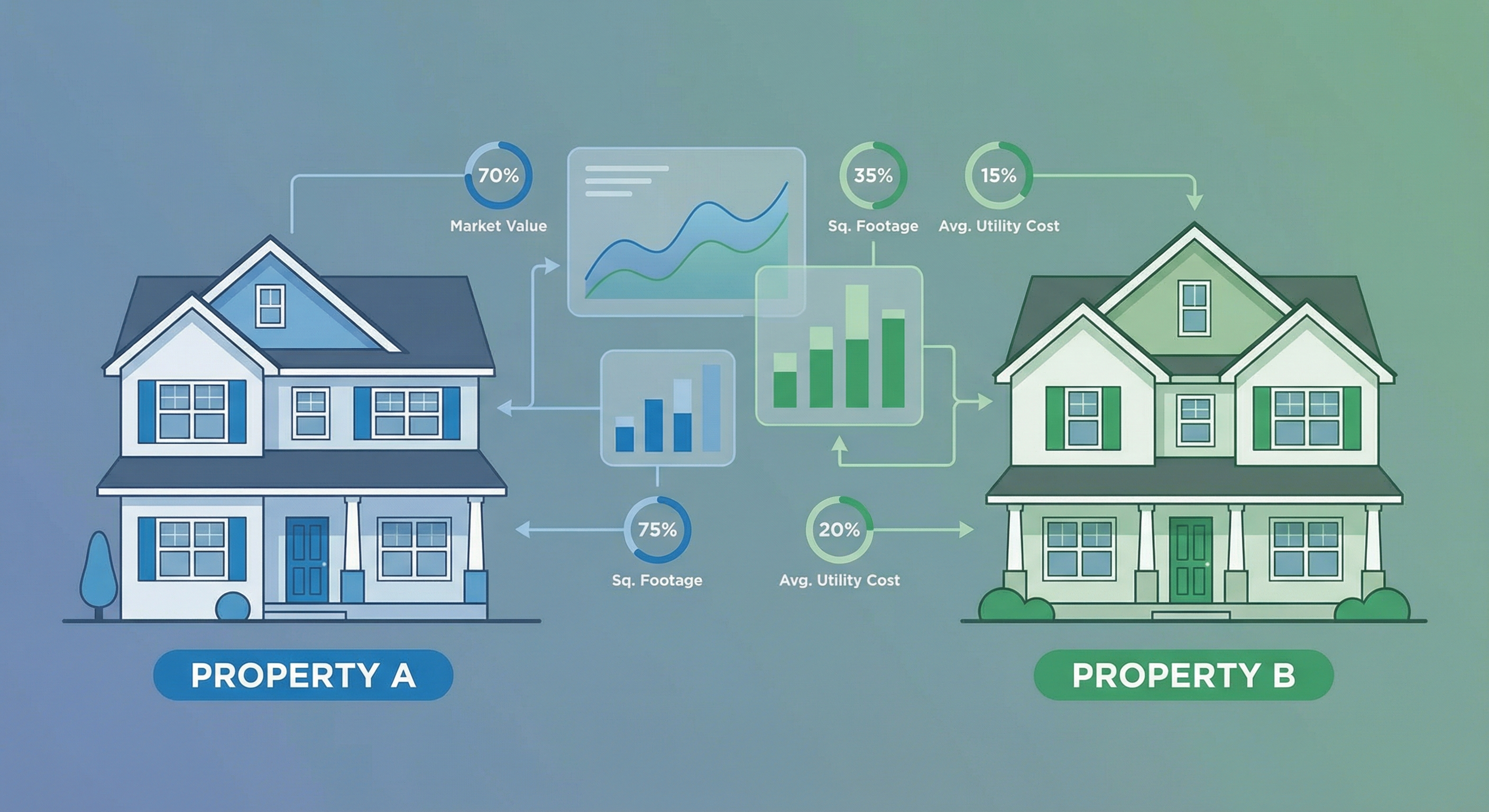
In Texas property tax protests, Comparable Sales (Comps) are your most powerful weapon.
But here's the harsh truth:
90% of homeowners choose ineffective comps.They either pick houses too far away, with vastly different square footage, or from the wrong time period. The result? ARB glances at your evidence, dismisses it as "not comparable," and moves on.
Today, we'll break down how to choose comps like a professional appraiser—making your case bulletproof.
---
🎯 What Makes a Property "Comparable"? Core Standards
A good comp must meet these 5 core criteria:
1. Geographic Proximity (Location)
Ideal range: Within 0.5 miles Acceptable range: Within 1 mile Red line: Beyond 1 mile (unless in rural areas) Why it matters: Real estate's first law is "Location, Location, Location." Two identical houses can differ 30% in value if one is in a good school district and the other isn't. Pro tips:- Prioritize properties in the same neighborhood
- If possible, choose from the same street
- Avoid crossing obvious geographic boundaries (highways, railroads, rivers)
2. Similar Square Footage
Ideal range: ±10% Acceptable range: ±20% Red line: Beyond ±25% Example:- Your home: 2,000 sqft
- Ideal comp: 1,800 - 2,200 sqft
- Acceptable comp: 1,600 - 2,400 sqft
- Unacceptable: 1,400 sqft or 2,600 sqft
---
3. Similar Build Year (Age)
Ideal range: ±5 years Acceptable range: ±10 years Red line: Beyond ±15 years Why it matters: New vs. old homes can have vastly different values (equipment, materials, energy efficiency standards all differ). Exception:- If your house has had major renovations (like new roof, HVAC, kitchen remodel), you can justify using slightly newer comps
- But you need renovation proof (Permit records, invoices)
4. Similar Property Type & Features
Must match:- Single-family home vs. townhouse vs. condo
- Single-story vs. multi-story
- Attached garage vs. no garage
- Bedrooms (±1 acceptable)
- Bathrooms (±0.5 acceptable)
- Lot size (±20%)
---
5. Recent Sales (Recency)
Ideal range: Past 6 months Acceptable range: Past 12 months Red line: Beyond 18 months Why it matters: Real estate markets change. A house that sold for $500K in 2024 might be worth $550K or $450K in 2026. More recent sales better reflect current market. Texas-specific rule: Under Texas law, Appraisal Districts value as of January 1. So:- If protesting in 2026, sales from around January 1, 2025 are most relevant
- July 2025 sales also work, but carry less weight
📊 How to Find Comps? 3 Data Sources
1. Appraisal District Website (Free)
Every county Appraisal District has public sales data. Example websites:- Harris County: hcad.org
- Dallas County: dallascad.org
- Travis County: traviscad.org
---
2. Real Estate Websites (Zillow, Realtor.com)
These sites have faster-updating sales data and friendlier interfaces. Steps: 1. Search your address 2. Click "See comparable sales" or "Recent sales" 3. Manually filter for qualifying properties 4. Screenshot or export data Pros: User-friendly, has photos, detailed descriptions Cons: ARB may question data source ("This is Zillow's estimate, not actual sale price") How to address challenges:- Cross-validate with Appraisal District official data
- Or get data directly from MLS (Multiple Listing Service)
3. Real Estate Agent's CMA (Most Professional)
CMA = Comparative Market Analysis Steps: 1. Contact a local real estate agent 2. Tell them you need a CMA for property tax protest 3. They'll pull MLS data and create a professional report Cost: Usually free (agents hope you'll use them when buying/selling) or $50-$150 Pros:- MLS data is most authoritative
- Agent helps filter and analyze
- Report looks very professional
- Requires contacting an agent, slightly more hassle
❌ 5 Fatal Comp Selection Mistakes
Mistake 1: Only Picking Low-Price Sales
What's wrong: You pick 3 sales all lower than your appraisal, but they're all 20% smaller and 15 years older than your house. ARB's reaction: "Of course these are cheaper—they're smaller and older. Denied." Correct approach: Choose truly comparable houses. If their sale prices are higher than your appraisal, then you shouldn't protest—your appraisal is already reasonable.---
Mistake 2: Using List Price Instead of Sale Price
What's wrong: You see a house listed at $480K and include it in your comps. But actual sale price might be $450K or $510K. Correct approach: Only use actual sale prices (Sold Price), never list prices (List Price).---
Mistake 3: Ignoring Special Circumstances
Some sales can't be used as comps, like:- Family Transfers: Parent selling to child, price may be below market
- Foreclosure Sales: Foreclosed properties typically sell low
- Short Sales: Seller forced to sell at loss
- Check Deed Type—if it's "Warranty Deed," usually a normal transaction
- If price is obviously abnormal (like $1), skip it
Mistake 4: Crossing School District Lines
What's wrong: You pick a very close comp, but it's in a worse school district. ARB's reaction: "Different school district, different value. Denied." Correct approach: Prioritize properties in the same school district.---
Mistake 5: Only 3 Comps
What's wrong: You only provide 3 comps. ARB flags 1 as "not comparable," and half your case crumbles. Correct approach: Provide 5-7 comps. Even if ARB rejects 1-2, you still have solid evidence.---
📋 How to Present Your Comps? Professional Template
A professional comps table should include:
| Address | Sale Date | Sale Price | Sqft | $/sqft | Year Built | Distance | Notes |
|---|---|---|---|---|---|---|---|
| 123 Main St (Subject) | - | $500K (Appraised) | 2,000 | $250 | 2010 | - | My Property |
| 125 Main St | 08/15/2025 | $460K | 2,050 | $224 | 2011 | 0.1mi | Same street |
| 127 Main St | 06/22/2025 | $470K | 1,980 | $237 | 2009 | 0.1mi | Same street |
| 200 Oak Ave | 09/10/2025 | $455K | 2,020 | $225 | 2012 | 0.3mi | Same district |
| 305 Elm St | 07/05/2025 | $465K | 2,100 | $221 | 2010 | 0.4mi | Same district |
| 410 Pine Dr | 05/18/2025 | $450K | 1,950 | $231 | 2008 | 0.5mi | Same district |
| Avg Comp | - | $460K | 2,020 | $228 | - | - | - |
| Mine vs. Avg | - | +$40K (+9%) | -20 | +$22 (+10%) | - | - | Overvalued! |
- Clearly shows your property vs. comps comparison
- Calculates averages
- Highlights the degree of over-appraisal
🚀 But Before You Start Hunting for Comps...
Finding comps is technical work and also physical work.
But the more important question is: Is your property actually worth this effort?If your appraisal only jumped 5%, and you spend 3 hours finding comps and making spreadsheets, only to save $200 in taxes, what's your effective hourly rate? $67/hour. Worth it?
This is why smart investors use tools for quick judgment first. TexasTaxSignal has already integrated sales and appraisal data across all of Texas. Enter your address and know in 30 seconds:- ✅ Your appraisal vs. neighbors' actual sale prices
- ✅ Your $/sqft vs. neighborhood average $/sqft
- ✅ Success Probability (based on historical data)
👉 Analyze Your Property For Free
---
Summary
Choosing comps isn't about "more is better"—it's about "more accurate is better."
A golden rule: > Rather than 10 barely-related comps, provide 5 perfectly-matched comps.ARB members review dozens of cases daily. They don't have time to deeply analyze each of your comps. If your first 3 comps are solid, they'll think you've done your homework and be more willing to hear your case.
But if your first comp is obviously not comparable (like vastly different square footage), they'll lose patience immediately.
So, quality > quantity.Good luck!
---
Author: TexasTaxSignal Team Last Updated: February 10, 2026---
> Not sure if your property is worth protesting? 30-second free analysis