DIY Property Tax Protest vs Hiring a Company in Texas: 2026 Cost Comparison
Should you protest your Texas property taxes yourself or hire a protest company? Compare costs, success rates, time investment, and find the smartest approach for your situation.
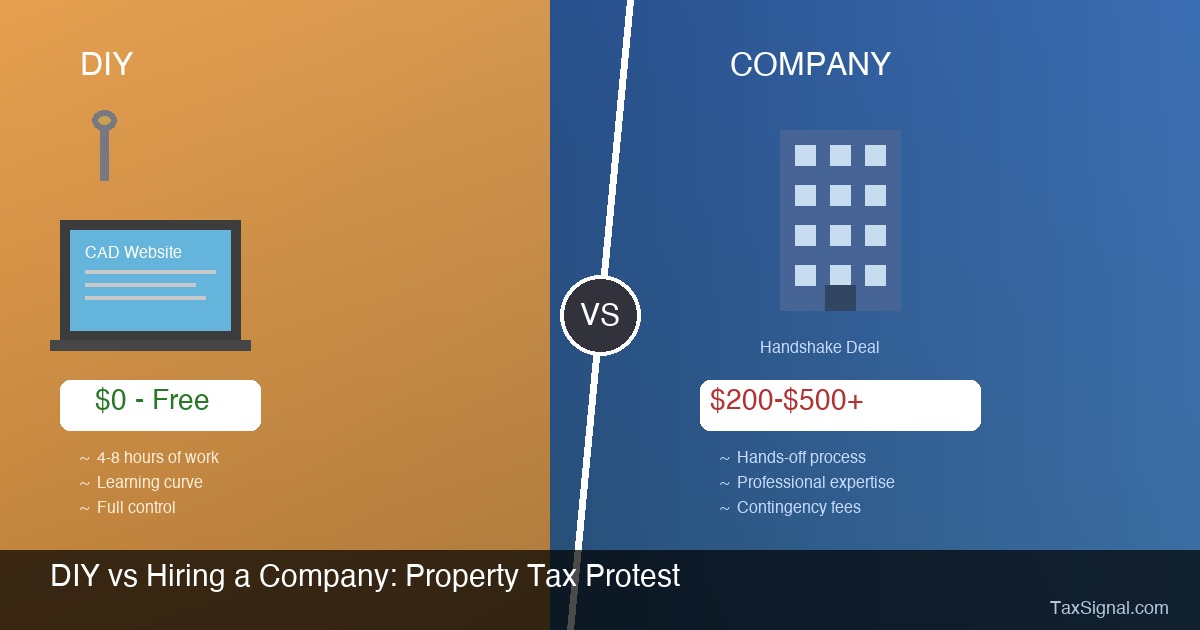
You got your 2026 Notice of Appraised Value. The number feels too high. Now comes the real question: do you protest it yourself, hire a company to do it for you, or find something in between?
Each approach has real trade-offs in cost, time, and results. This guide breaks down all three options with actual math so you can pick the one that fits your situation---not someone else's sales pitch.
---
Option 1: Full DIY Protest
Filing a property tax protest yourself costs nothing but time. Texas law gives every property owner the right to protest directly with their county appraisal district, and thousands of homeowners do it successfully every year.
How It Works
1. File your protest before the May 15 deadline (or 30 days after your notice, whichever is later) 2. Research comparable sales in your neighborhood 3. Gather evidence: recent sales, photos of property condition issues, repair estimates 4. Attend an informal hearing (phone, in-person, or online depending on your county) 5. If unsatisfied, escalate to the Appraisal Review Board (ARB)
Pros
- Zero cost --- you keep 100% of any tax savings
- You learn how the system works, making future protests easier
- Direct control over your case and evidence
- No contracts, no percentage owed to anyone
Cons
- 4-8 hours of research to find comparable properties, pull sales data, and build your case
- You need to understand what qualifies as a valid comparable
- Navigating county websites and public records can be frustrating
- Mistakes in evidence selection can weaken your case or waste your hearing
- Scheduling and attending hearings takes additional time
Best For
Simple cases where the over-assessment is obvious, homeowners with time and willingness to learn, and properties with clear comparable sales nearby.
---
Option 2: Hiring a Property Tax Protest Company
Texas has dozens of companies that will protest your property taxes on your behalf. They handle everything from filing to hearing attendance.
How It Works
1. You sign an authorization form giving the company agent-of-record status 2. They file the protest, research comps, and attend hearings for you 3. If they win a reduction, you pay a contingency fee---typically 25-40% of the first year's tax savings 4. If they don't win, you pay nothing
Pros
- Zero time investment on your part
- They handle all paperwork, research, and hearing attendance
- Experienced agents know appraisal district tendencies and negotiation tactics
- No upfront cost---you only pay if they succeed
Cons
- Contingency fees add up fast. On a $30,000 reduction, you could owe $1,500-$3,000 in fees---for a single year's work
- Many companies file thousands of protests with the same templated evidence
- You lose control: they negotiate on your behalf, and their incentive is volume, not maximizing your individual reduction
- Some companies lock you into multi-year contracts
- For smaller reductions, the fee can eat most of your savings
The Math on Contingency Fees
Let's say your property is assessed at $400,000 and gets reduced to $370,000. At a typical Texas tax rate of 2.5%, that $30,000 reduction saves you about $750 per year.
With a protest company charging 40% contingency:
- Your savings: $750/year
- Company's fee: $300
- Your net savings: $450
Best For
Property owners with genuinely zero time to spare, commercial properties with six-figure assessments where professional negotiation justifies the fee, and complex cases involving unequal appraisal or income-based valuation.
---
Option 3: Data-Driven DIY with Analysis Tools
This is the middle ground that most residential property owners overlook. Instead of doing all the research yourself or outsourcing everything to a company, you use a data analysis tool to get the evidence and strategy---then file the protest yourself.
How It Works with TexasTaxSignal
1. Enter your property address 2. Get a full analysis report including comparable sales, neighborhood data, assessment deviation, and a recommended protest strategy 3. Use the report as your evidence package at the informal hearing 4. File and attend the hearing yourself (typically 15-30 minutes)
Pros
- Flat fee of $29 --- not a percentage of your savings
- Professional-grade comparable analysis without hours of research
- You keep 100% of your tax savings beyond the tool cost
- Evidence is organized and ready to present
- County-specific strategy and deadline guidance included
Cons
- You still need to file the protest and attend the hearing (though this is straightforward)
- Requires basic comfort with following a process
- Not a replacement for a tax attorney on genuinely complex legal disputes
The Same Math, Different Outcome
Same property: assessed at $400,000, reduced to $370,000, saving $750/year.
- TexasTaxSignal cost: $29
- Your net savings: $721
Best For
Most residential property owners. Especially investment property landlords who protest every year and want to stop giving away hundreds or thousands in contingency fees.
---
Side-by-Side Comparison
| Factor | Full DIY | Protest Company | TexasTaxSignal |
|---|---|---|---|
| Cost | $0 | 25-40% of savings | $29 flat fee |
| Time investment | 4-8 hours | Near zero | 30-60 minutes |
| Research quality | Depends on your skill | Varies by company | Data-driven analysis |
| You keep (on $750 savings) | $750 | $450-$563 | $721 |
| Control over your case | Full | None | Full |
| Comp selection | Manual | Company chooses | AI-assisted |
| Multi-year cost | $0/year | Fee every year | $29/year |
| Learning curve | Steep first time | None | Low |
When Each Option Actually Makes Sense
Go Full DIY When:
- Your over-assessment is obvious (e.g., the appraisal district has the wrong square footage or missed major damage)
- You enjoy the process and have time to research
- Your expected savings are small (under $200), making any fee hard to justify
- You've protested before and already understand how to pull comps
Hire a Company When:
- You own commercial property with assessments in the millions
- Your case involves complex legal arguments (unequal appraisal, income approach valuation)
- You genuinely cannot attend a hearing under any circumstance
- The property is out of state and you need someone local
Use a Data Tool When:
- You own one or more residential properties (SFH, investment, rental)
- You want solid evidence without spending a full day researching
- You protest annually and are tired of paying contingency fees
- You want to understand your property's position in the market, not just get a number
The Hidden Cost Most People Miss
Here is what rarely gets discussed: contingency fees compound over time.
If you hire a protest company for 5 years and save an average of $750/year, you'll pay roughly $1,500 in fees over that period (at 40% contingency). That's money that could have stayed in your pocket with a little bit of preparation.
For investment property owners with multiple properties, the numbers get even more dramatic. Three rental houses at $300/year in fees each means $900/year going to a protest company---for work that takes them 15 minutes per property.
A flat-fee tool at $29/property for those same three houses costs $87/year. The difference over five years is over $4,000.
---
The Bottom Line
There is no universally right answer. Protest companies exist for a reason, and for certain property types and situations, they earn their fee. Full DIY is legitimate and works well for people willing to invest the time.
But for the majority of Texas residential property owners---especially landlords and investors who protest every year---the smartest move is in the middle. Get the data and evidence from a tool built for this purpose, then spend 30 minutes filing and presenting your case.
You already manage your properties. You already handle leases, repairs, and tenants. Filing a property tax protest with solid evidence in hand is one of the easier tasks on that list---and one of the most financially rewarding.
Ready to see if your property is over-assessed? Check your property on TexasTaxSignal --- free initial analysis, no commitment.